Bogotá: Conversations in Spray Paint
There's reputation and reality. Sometimes, the former persists even if the latter can disprove it.
Reputations seem to endure for mainly two reasons: beauty and danger.
A beautiful place sparks all the whimsy and storybook magic in the traveler's imagination, and it will always maintain that allure. Paris, Barcelona, Sydney, Venice... all the cliche places maintain their status pretty much indefinitely. Whether it's real or, more likely, mob psychology there's a pressure to keep the story going, regardless of personal experiences. I mean, how often do you see content bad mouthing these coveted destinations? Their international reputations are locked in beyond the millions that have actually walked the streets, witnessed the great architecture, sipped the coffee, reveled in the local festivals, and fawned over the food. Since they're cemented as wonderful places, their less desirable traits are all but erased from public discourse.
Then, there's the opposite side of the reputational coin. These places have endured wars, international or civil. They're known for crime rates, rampant poverty, and low incomes. Their turbulent pasts, no matter how long ago, remain sound bites and footnotes placed within every editorial about them, especially when there's an undercurrent of positivity, hope or change. Even if there has been tangible and sustained progress, a "danger" asterisk seems to hover, like a perpetual dark cloud. And sadly, the wider world will never know their beauty because the negative headlines will always propagate farther and louder than anything positive. (Just ask anyone from Detroit.)
By way of reputation, Bogotá lives with the asterisk. Just two days before my flight, my Apple News travel feed posted a top ten list of most dangerous countries for solo travelers. Care to guess who was solidly in the top 5?
Yup, Colombia.
Then, as I'm waiting to board my flight, I am messaging with a friend in Morocco. As I discussed my plans to travel in Colombia for the next few months, she warned me to be very, very careful because the country is very dangerous due to all the cartels and guns. As a U.S. citizen, I don't consider the amount of guns in Colombia a concern considering there are more private guns in the United States, and people that hope to use them, than any other country on the planet. Also, we seem to consistently lead all other countries in mass shootings, many of which happen in schools.
My friend has never been to Colombia. She's not been outside of Morocco, but Colombia can't escape its reputation built from history.
The U.S. State Department's travel advisory website lists Colombia as the second most dangerous country in South America after Venezuela, which Colombia shares a large eastern border with.For U.S. citizens, Colombia is a travel advisory level 3+ (a few areas are level 4). Essentially, the U.S. government is telling Americans that you should reconsider traveling to Colombia.
While I understand not traveling along the Colombia-Venezuela border, what's really behind Colombia's travel advisory? Is it just politics, especially as Colombia's president initially and publicly opposed the Trump administration's immigration policies and, especially, the handling of immigrants being deported? Also, when the advisory speaks about the threat of kidnapping for ransom, is this really for everyone or the representatives of major U.S. corporations that continue to fund armed groups in order to exploit Colombia's vast natural resources for their own profits?
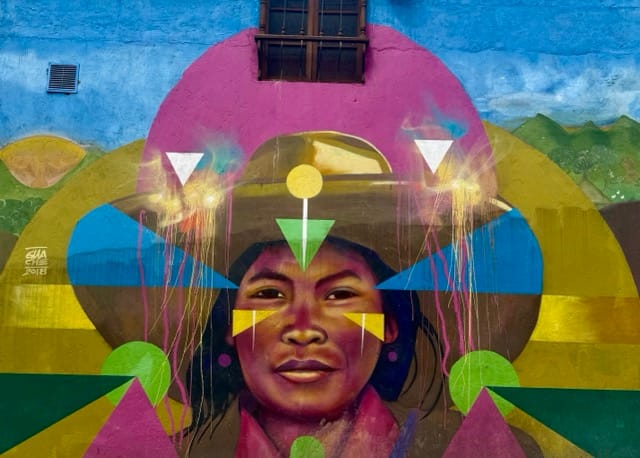
Bogotá's reputation as a gritty place could be influenced by the graffiti and street art that saturates all available spaces. This artistic medium itself is largely misunderstood, especially in "western" nations that consider its presence bad for property values or a signal they've crossed into a lower income, aka "dangerous", section of the city.
The public art in Bogotá is a public service, a tangible, hypercolored connection to this vibrant nation's deep history and a visual feast of thought provoking commentary. The notion that graffiti or street art is an indicator of entering a city's underbelly is based solely on ignorance and a discomfort with the medium's unabashedly uncensored freedom of speech and expression. As Banksy, famous street artist and social commentary starter, once tagged on a wall, "If graffiti changed anything - it would be illegal.”
In Bogotá, public art (graffiti) is not illegal, merely prohibited. However this change didn't happen without a watershed moment centered on tragedy.
On 19 August 2011, Diego Felipe Becerra, a 16-year-old, was shot in the back after an officer chased him for attempting to graffiti tag the columns of a vehicular bridge in northwest Bogotá. Diego's parents fought back against the police cover-up which framed Diego for performing an aggravated robbery with a weapon, which the police planted on him.
Diego's parents had the influence and resources to fight back, unlike many of the victims before him. He was a teenager that just wanted to be recognized by his peers. While the wheels of justice turned slowly, Diego's parents were able to get justice for their son and this facilitated the city mayoral administration to make a change.
Decreto 75 was implemented by Bogotá mayor Gustavo Petro in 2013. This decree moved to regulate street art and graffiti writing to promote "responsible and artistic" public art. Though that definition is very vague and subjective, it was a step forward in a city awash in paint. Decreto 75 contained some very specific articles to define the types of graffiti that were acceptable, keeping it from being commercialized by corporations by prohibiting commercial messaging, a list of places where graffiti is not authorized (only 17 places), and pedagogical and promotion strategies to change the thought it's a "vandal" activity.
The framework was a starting point to regulate street art and lean into its cultural and economic value, along with it's ability to rehabilitate neighborhoods. This spawned public funding for street art projects. The government funded projects are a drop in the bucket, but they are important to Decreto 75's goal of changing the general perspective that graffiti and street art are vandal activities.
Another avenue is private funding from businesses, corporations, and nonprofits. For the community, having funded and approved projects is really important, but there are far more artists than funds, meaning the rebellious spirit remains vibrant as the artists continue to express themselves everywhere in this sprawling metropolis.
And yet, from my outsider perspective, there appears to be an acceptance of public art that doesn't exist as openly in other major international cities. Sure, I can wander London's side streets and see some wonderful art, but it's not covering every available surface the way it does here. When you walk the streets of Bogotá, the sections of walls, permanent or temporary, that aren't painted or tagged in some way feel suspiciously out of place. And if there are no marks, be sure someone has noticed and will return to claim that space for themselves.
The history of graffiti has as many layers as the paint on the walls. The opportunity to make something beautiful, spread your name as the writers do, and gain a bit of notoriety. Like any other artistic medium, the community knows each other. If you're like me, the work of writers will seem completely foreign and difficult to conceptualize that there's a name within the multidimensional, perfectly balanced tag as each artist develops and showcases their own style.
Usually, writing is the beginning of an artist's spray painted journey (and in my workshop I experience why). Tags fill the urban landscape, which is a constantly evolving record of the artists' attempts to build credibility and a reputation amongst their peers. The location, difficulty and artist's daring are important factors. Splashing a tag somewhere no one else can, or dares, go quickly vaults the artist into the stratosphere. When two Colombian artists tagged both sides of Bogotá's tallest skyscraper, their reputations were boosted faster than the paint from their cans.
While graffiti and street art are significant for the artists and their global community, every day these pieces are witnessed by people, with possibly no art or graffiti knowledge, making the medium's impact incalculable. However, in Bogotá, the sheer volume of artists, aficionados, followers, and citizens living in this constantly evolving visual conversation increases the likelihood the shockingly bright and psychedelic creation on the street corner will elicit a reaction.
Public art is an open, direct, and unfiltered conversation. These conversations are increasingly important in a world filled with disinformation and censorship by governments and the corporations that prop them up. Public art is the rebellious spirit of the people. And, this spirit has always been critical to society, especially when it feels like humanity, as a whole, is regressing. Algorithms control the social media feeds and search engines. Advertisers and money-centric corporate boards control traditional media streams. Nothing and no one can control a person with a purpose that grabs a spray paint can and makes their statement for all to see.
The public art pieces on Bogotá's streets speak to universal issues, while showcasing Colombia's rich cultural depths. As I wandered Bogotá's gigantic grid of calles, carrerras, and avenidas, there are pieces speaking about humanity's greatest struggles. Behind Procuraduria General de la Nacion, there is a large, independently funded piece, the last wall in a series of seven across the country, by a nonprofit organization dedicated to victims of violence, including social leaders, and forced displacement with the powerful phrase "cosecha dignidad" (Harvest Dignity).
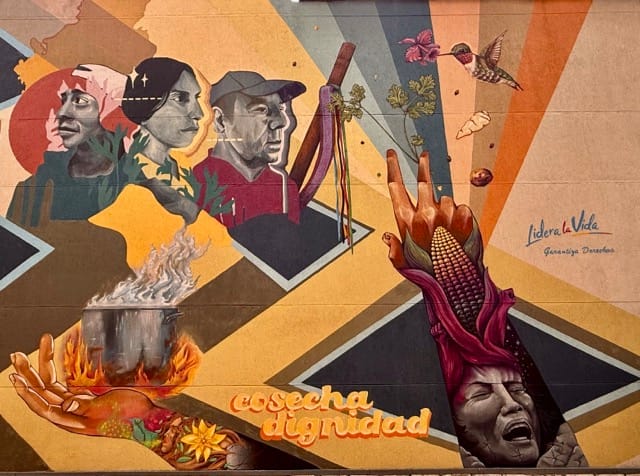
While an agreement was signed between the Colombian government and the Revolutionary Armed Forces of Colombia (FARC) in 2016, ending a long running civil conflict, this didn't return the land to the people. There are still a lot of armed groups, cartels, and criminal organizations trying to control large swaths of land for trafficking and exploitation. Also, like every other resource rich country in the world, global corporations, especially in mining, are trying to own every available parcel of land to boost their profit margins. Colombia's indigenous groups continue to fight for their right to their ancestral lands. They have threads of connection that predate Spain's, and Catholicism's, arrival on these ruggedly beautiful shores.
While this large, government funded public art piece draws attention, among the calles and carrerras there are constant reminders of the beautiful and powerful mythology of Colombia's desecendants. It's rare to walk a technicolor street and not see indigenous references whether it's maize, jaguars, butterflies, hummingbirds or women in the traditional pollera skirt, adorned with magnificent colors and patterns. These subtleties are the constant reminder of where the strength of the Colombian people originates from.
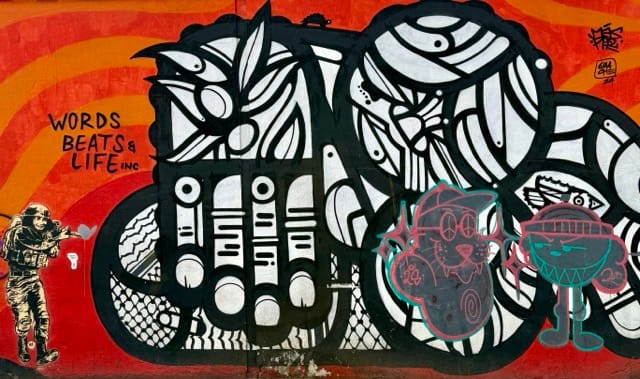
Alongside the indigenous iconography is support for all human rights, regardless of the country. Colombians are very familiar with oppression, especially at the hands of malevolent foreign nations, so there is clear support for Palestine's struggle against Israeli apartheid and genocide. On the southwest corner of Calle 20 and Carrera 4, there is a large, black and white piece in support of the struggle of Palestinians, created my MásPaz. When another artist decided to put up Anne Frank as an Israeli Defense soldier alongside it, another artist used their voice and painted a heart at the end of her gun barrel. This is just one example of the ongoing visual discourses unfolding on Bogotá's walls.
In Chico Norte, close to Parque 93, which I would consider a more wealthy section of the city, Toxicómano put up a large piece in support of the ongoing fight against U.S. Immigrations Customs Enforecement (ICE). This message is more likely to resonate in this area considering there's a large international presence. Another example of rebelling against oppressive forces, especially as the U.S. government has openly broadcast that they're targeting any person with Latin roots, which is generic government terminology for racistly targeting brown people.
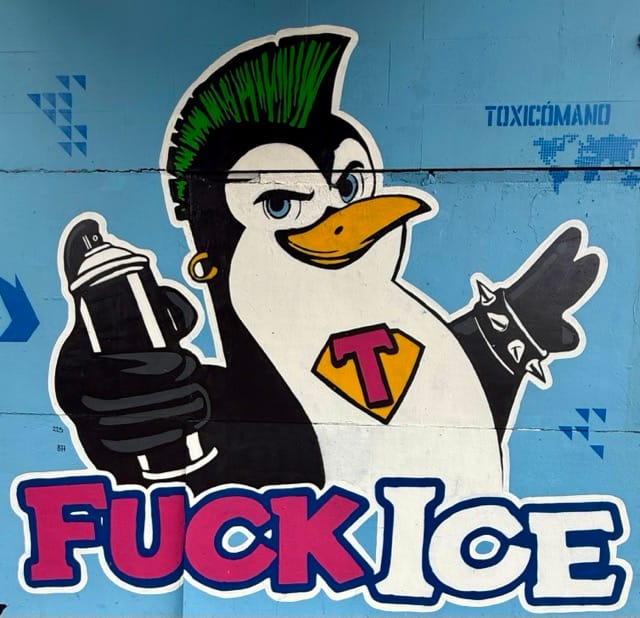
Public art reminds the people of their struggles for progress and the need for government accountability. It's no secret governments are corrupt. In every country, there are clear signs that the elected people are more interested in their own wealth and power than upholding promises to the people. Colombia is no different. I am not going to point a finger and scream about how corrupt their levels of government are because I could say the exact same about my own (regardless of whether it's Republican or Democrat controlled).
Social justice needs everyone's voice to fight against institutional corruption and create positive change. On the corner of Avenida Ciudad de Lima and Carrera 4, there are solemn art reminders for Dylan Cruz, an unarmed 18-year-old man that was murdered by members of Colombia's Mobile Anti-Disturbance Squadron, a loathsome contingent of the country's riot police, during an anti-government protest in 2019. He was shot in the head as he was running away.
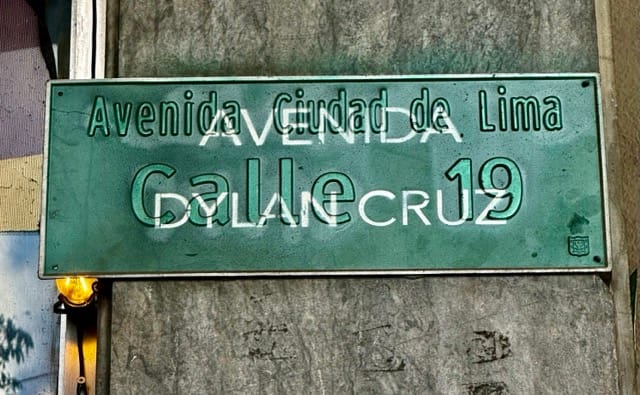
The corner is filled with details honoring Dylan's courage and sacrifice. As I stood there staring at the street sign, which was painted over and renamed "Avenida Dylan Cruz", it had been seven years since Cruz's murder. And while the "wheels of justice" had slowed, even grinned to a halt, for Dylan Cruz, the people were not done. They continue to provide visual reminders about the people lost in pursuit of positive change. While in the U.S., I have seen murals for George Floyd, Breonna Taylor, Ahmaud Arbry, Trayvon Martin, and Michael Brown, all victims of racism, inequality, and police brutality in the United States, it's Colombia's public art community's persistence and dedication to reminding the larger community of their importance and the need for social change that strikes me.
The power of public art lies within the courage to rebel and speak out. Sure, there are plenty of artists, whose identities are known, but, in my opinion, the anonymous work is the most thought provoking. Without any context other than the paint, stencil, paper or sticker on the wall, the message can't be clouded by the viewer's internal biases towards the actual artist. Even if they have a bias against the medium itself, which is likely as some see it as a crime or, at least, a nuisance, the words and iconography stand on their own.
As I headed towards Ocio Gallery in La Macarena district of Bogotá for my graffiti workshop, I came across a rather pristine off-white building, except on it's corner in black spray paint, there was a hastily tagged equation, "Gentrificación = Muerte." I have no idea who did this. I know nothing about the person that did this except they felt strongly enough to pick up a can and let the world know their thought.
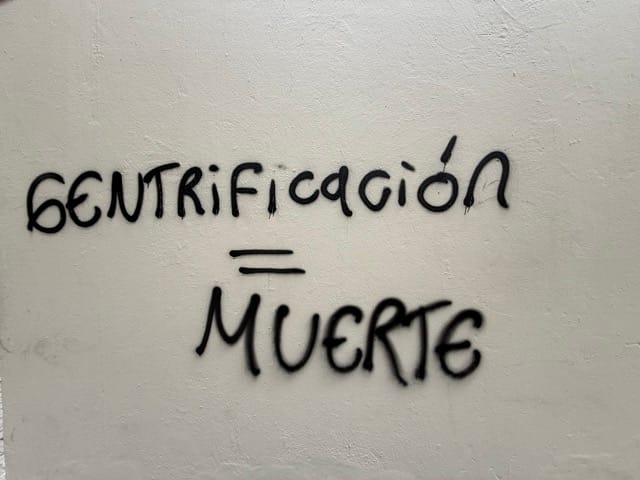
Anytime you experience art, I believe the first moments are the most profound because your initial feelings are your truest expression, before the analytical side of your brain tries to cloud your feelings. Whether the art is simple or complicated, beautiful or amateurish, legal or not, it provokes a response. Within that window, you are gifted an opportunity to better understand yourself.
This simple tag achieved the heights of purpose by giving me something to think about, vocalizing dissent to gentrification that, as a traveler, I might never know about, and provoked discourse, as I'm including it within this writing and continue to have conversations and contemplate my role, as a nomad, in this ongoing social epidemic that's being cleverly marketed as "progress." Even the simplest expressions of the art form are necessary because all voices need to be heard, and not solely within the echo chamber of their peers and community.
As with all movements, public art needs its stewards too. In Bogotá, Capital Graffiti Tours and Ocio Gallery are two of them.
Public Art Stewards
Capital Graffiti Tours and Ocio Gallery fill critical roles for the public art community and greater society.
Capital Graffiti Tours is a champion for public art's history, knowledge, discourse, and education. I have always enjoyed graffiti and street art and make a point to document my favorite pieces as I travel the world. However, I had never received a level of education and understanding that I did during their free two hour tour.
The twice daily free graffiti tour (donations welcomed), beginning outside Museo del Oro, is called, "Politics & Graffiti Tour." Considering the tours are given by graffiti artists and people intertwined with the community, they are committed to educating people about public art's history and presence. My guide Jay provided an in-depth, dissertation-level knowledge of graffiti that made for a spectacular experience. He explained aspects of the culture that are completely invisible to greater society, which confirms that almost all of us have created opinions with either the tiniest sliver of information or, more likely, none at all.
During my tour, Jay never shied away from tough questions or opinions about graffiti being a nuisance or illegal. Sure, people pass every day and see paint on the wall, but getting people to think about all the went into the paint is where the true magic is. This requires the details and facts that actively work to counter fear-based propaganda, challenge the stigmas, and move the conversation forward.
My tour didn't avoid the controversies or feelings of people that believe public art, in its most raw forms, are a scourge. Everyone is entitled to their opinions, but as I listened to the importance of graffiti, it's easy to see those opinions as ignorant because they lack information and understanding. I mean, ignorance in general is usually fueled by limited exposure to a wide variety of information and perspectives. Why would negative opinions about public art be any different?
The simple fact that the tour is free, donations are welcome but not required, shows their commitment to educating as many people as possible about the art form. A required fee, while practical, would undoubtedly limit their exposure to a wider array of people. Also, they have several other tour options, such as the Graffiti bike tour, Distrito Graffiti tour, Chapinero Art by Night, and a Graffiti workshop (which takes place at Ocio Gallery).
Capitol Graffiti Tours is more than simply enjoying the beauty of public art and appreciating the hyper talented, anonymous (to the general public) artists that paint their passion and feelings on a public canvas. They are working to change the narrative about the importance of public art, in all its forms. While the art they highlight is important, it's the deeper knowledge and understanding that comes from being active within the community that makes the tour unique.
Ocio Gallery, where my tour ended, is a retail space filled with original art, prints, and other artisanal goods from over 80 local artists. The gallery addresses the biggest obstacle in any art community: market access. Art is a luxury item. The average person doesn't collect art because when you're struggling, buying art isn't anywhere on your survival bingo card. However, the standard art gallery communities won't necessarily access the right markets either, or they may even shy away from some of the more politically charged art, which can be a core component of street art.
Ocio gallery gives artists a platform and brings the market to them, as Capitol Graffiti Tours twice daily free graffiti tour ends there. This arrangement at least guarantees there are daily customers with some interest, no matter how recent, in the work the artists produce. Guaranteed entrance into a market is critically important as interest in public art grows and more artists enter this space. Like any business, when there's a surplus, the competition for contracted work, government or private, becomes more fierce.
Ocio Gallery provides a steady market of educated customers, even if very recently educated, and a space for artists to sell their work at prices that accurately reflect their value. The gallery's connection to the public art community strengthens the impact and importance of the work adorning the freeway walls, buildings, and parks across the city. Also, they are an unpretentious, welcoming education center as well. Their courtyard is a visual record of the thousands of people that have wandered through their doors and left paint on their walls, considering at the end of the free tour they let you tag your name.
While you don't need to be an artist to appreciate art, there is a certain level of understanding that only comes from trying your hand at it. Capital Graffiti Tours graffiti workshop provided me the opportunity to gain basic knowledge, learn some rudimentary techniques, and create my first tag. There is no education that can rival experience. Like almost everything else, graffiti abides by this universal principle.
My instructor Daniel, a talented graffiti artist that loves writing, walked me through color theory, proportions, balance, tag preparation, spray paint nozzles, and touched on various spray techniques in the first 45 minutes. Then, it came time for me to create my own tag.
He asked me to choose a word that was 5-letters or less. From there, I sketched the word using bubble style, apparently the most introductory writer style. However, I had a creative idea and designed something I liked better with Daniel's guidance. Then, it was time to put paint on the wall. This is where the real understanding lies.
In Ocio Gallery's courtyard, using the natural features of the concrete and marks from graffiti I was about to cover up, I created my rectangular canvas. The need to create balanced symmetry between my three letters fueled intense concentration, even though this was literally my first attempt. Once the grid was completed, Daniel mentored me through creating layers, accents, useful spray techniques, and balance.
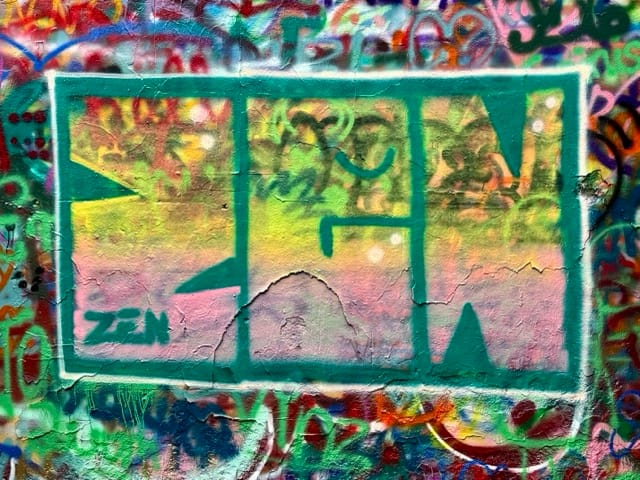
The last one is potentially the most difficult because it requires self aware self editing. While normally "less is more", I learned in graffiti that less is less and more is too much. Each addition of paint is permanent. There's no easy removal, but a distinct possibility that after one errant mark, you might add others to balance it out. This can quickly snowball into a convoluted conjuring of something far from your original design. Obviously, I can see how important preparation is, but how often in the moment do you make a split second decision, in violation of the "plan", and the result isn't what you wanted? Graffiti requires strong creative discipline.
Now, let me account for the ease of my environment. I had permission and time to create this tag. While it didn't take that long, normally I wouldn't be agonizing over it like a painter's canvas. These artists sometimes take only a few minutes to throw up a tag. Also, they may be under the cover of darkness, on top of a building, hanging off the side of a bridge or the back of a bus, using speed and precision with each pass of their cans in order to get it right.
Beyond being a lot of fun, this workshop's real impact was how differently I look at graffiti's most ubiquitous style. More people should try it because this provides the experience and knowledge to develop a more informed perspective.
But, for as informed as the people that attend the tours and shop in the gallery are, there will always be difficult public discourse about the medium's rebellious spirt.
Hard Conversations
It's really about simple mathematics. There will always be more artists than paid opportunities. But, if there aren't paid opportunities that won't stop artists from creating. Also, the money doesn't change the community's cultural dynamics. If anything, the old school methods of gaining attention and notoriety are more effective due to the speed social media updates the global community. While that's true to their roots, this fuels the opposition's attitude towards their art.
Currently, Bogotá is undergoing major construction on Avenida de Caracas as the city's train system is slowly coming into existence. There are gigantic concrete pillars for the elevated train that will bisect this sprawling urban landscape. Of course, with something as high profile as a new train system, this is a clear opportunity to build a personal legend and solidify Bogotá's reputation as the street art capital of the world. (I don't know that's ever going to be in doubt).
And, the public art community has already taken notice. Several graffiti artists on a culture podcast recently commented about the new trains being a high profile opportunity to lay down their tags. They're graffiti artists! Of course they're going to want to be one of the first to mark the trains. I think it's understood the concrete columns will be tagged, probably long before the first scheduled train trip. In New York City in the 1980's, Lee Quiñones became famous because he was tagging the subway cars. He ended up working with Fab 5 Freddy and Jean Michel Basquiat. Let's say the formula isn't new, but proven to provide results.
However, these comments, while understandable and completely honest, provide the fuel for the campaigns against graffiti artists. The same government that provides public funds for projects uses these moments to instill fear about graffiti's dangers and hooliganism. If humanity has demonstrated anything, preying on fear works. There isn't informed discourse or discussion about facts. In these moments, all the positives of street art will be slid into the shadows to fulfill one of the current administration's goals. I mean, I could say that about every aspect of politics, but by stoking these fears and portraying them as vandals, which Decreto 75 had an article against, they are putting a whole group of people in danger.
This fear fuels the hatred. Hatred is always based on ignorance, usually dictating that people with those views do not think rationally about the actions. In this case, the artists have received death threats. Along with the death threats, comes the frenzied supporters that have talked about everything from capital punishment for graffiti to the need to "cleanse" society of them.
Really?? This is the reaction to paint on some walls? Pillars? Trains? Buses? Sure, that can be shrugged off as internet comments, but with the increase in political violence across the world, this should still concern everyone as a society.
There will always be controversy and disagreements. The art's rebellious spirit helps fuel change, which will always anger some and make others uncomfortable. It's the one of the laws that governs the universe, and everything within it, for every force their will be an equal and opposing force.
There will be no end to this struggle. The only way forward are conversations, no matter how difficult and impossible they may seem. Any future will require both forces to take a long, hard look at themselves instead of constantly pointing figures or laying blame at their opponent's feet. Like in all conflicts, the shared humanity needs to be at the core.
For the public art community, this is where anonymity works against them. It's easy for opponents to demonize them as vandals when there is no face to go with the work. It's also understandable that the artists want to remain anonymous to the public and, especially, the government as there are legitimate concerns about corruption, violence, and their safety.
If someone had heard the police brutalized and/or killed a vandal, there might not be many ripples in the greater societal pool. Like anything, when there's a face, the harshest of opinions tend to soften, even if just a little. Just think about Diego Felipe Becerra. Was he a danger to society? Does anyone really believe the world is better without him?
This is why Ocio Gallery and Capitol Graffiti Tours are so important to this hyper-visualized battleground. They allow for open dialogue that eliminates the bias and algorithm fueled middle men. Yes, the guides are pro-public art, but they provide a vital service to the greater community by sharing a deeper knowledge and understanding from the community itself.
There isn't a big, one-size-fits-all solution. In fact, there is probably only little, tiny baby steps, but anything is more constructive than dangerous language that puts people at risk because they have a passion to create art and share it with the public.
The Wrap-up
Public art is rebellious, beautiful, controversial, creative, progressive, stigmatized, and absolutely necessary.
From tagging with a fat marker to writing on a bus to skyscraper sized pieces of cultural mythology, every addition of paint is a voice, a statement, a reason to stop and think. Humanity has always relied on the dreamers, the rebels, the outsiders to provoke the wider public out of their comfort zone and fuel forward progress.
Public art are the visual conversations that we need to have. Sometimes those conversations are complex. Sometimes it's as simple as providing a moment of beauty that sticks with you through your day. There is no right or wrong answer. It's also a permanent impermanent record of history, the present, and dreams for the future.
Bogotá is the case study for public art's power and influence in creating a better future by capturing the present with every aerosol propelled burst of paint and immortalizing history's significance. And, this happens in the one language everyone understands: striking visuals.
From humanity's first cave paintings to now, the power of visuals is unquestionable. There is no required literacy level or need for stuffy, pretentious gatekeepers. Truly, this is the people's art and Bogotá is its capital.
From the creativity to take the 26 letters of the alphabet and make them into their own unique style to showcasing a crucial piece of mythology on the side of skyscraper, we all benefit from public art in all its forms. Everyone should appreciate the artist's passion and courage to make their feelings known by transforming a nondescript surface into a thought provoking conversation starter.
Public art, street art, graffiti is preserving the rebellious spirit that doesn't accept the status quo, pushes the boundaries, and remains committed to fighting for a future as bright as the paint in their cans.
(Author's note: I would like to thank Jay from Capital Graffiti Tours and Ocio Gallery for responding to my many questions and constant follow-ups. If you're in Bogotá, definitely check them out! Thanks Jay!!!)